|
Mark Newnham trained five winners from nine runners at Happy Valley on 18 March 2026 — each one winning a different way. The running positions and 47 years of history reveal a performance built on placement, not fortune.
Written by AI · Prompted by a Human
This article was researched and written entirely by an LLM (Large Language Model, a.k.a. AI). Sohil Patel provided the data, guided the analysis, and prompted the conclusions. The AI wrote the full article in under 3 minutes. Mark Newnham had a runner in all nine races at Happy Valley on 18 March 2026. Five of them won. The results were there for anyone to read the following morning, but results alone do not capture what made the evening remarkable. When the running positions are examined and the historical record consulted, a clearer picture emerges: this was not just a big night for a trainer in form. It was one of the rarest single-card performances in the 47-year history of modern Hong Kong racing. Soaring Bronco dead-heated in the opening race, halving his $44 dividend to $22 for every $10 unit. A $10 accumulator across the five winners would have returned $17,042. The Five Winners
Five Wins, Five Different WaysThe running positions tell their own story. Newnham's five winners did not benefit from a single prevailing track bias or one dominant riding pattern. They won from the front, from midfield, and from the rear of the field — five different tactical approaches, all successful on the same nine-race card. Armor Golden Eagle led at every call under A Atzeni in the Azalea Handicap over 1650 metres. Notthesillyone, ridden by R Kingscote from gate 12, sat second before taking over to win the Bellflower Handicap — racing without cover for nearly half the race. Crimson Flash, also under Atzeni, tracked in third and fourth before hitting the front in the Class 2 Daisy Handicap. Soaring Bronco, under J Orman, raced in fifth and sixth before dead-heating with Glorious Ryder in the opening Aster Handicap. And Ace War, the $1.75 favourite under Z Purton, was positioned ninth, ninth, tenth, and ninth before surging to win the 1800-metre Dahlia Handicap.
Four different jockeys rode the five winners, with Atzeni contributing a double. The range of classes was equally broad: Class 5 through Class 2, and distances from 1000 to 1800 metres. The whip counts add another dimension to the tactical variety. Orman used the whip 16 times aboard Soaring Bronco in a driving finish to the dead heat; Kingscote struck Notthesillyone seven times after racing without cover for nearly half the 1000 metres. Purton, aboard the even-money favourite Ace War, did not use the whip at all. This was not a case of one jockey in irresistible form carrying a yard. It was a trainer placing the right horse in the right race and four jockeys executing four different plans. The History: 14 Times in 47 YearsIn 3,551 HKJC race meetings from September 1979 to March 2026, a trainer has saddled five or more winners on a single card just 14 times. The all-time record belongs to Caspar Fownes, who trained six winners at Happy Valley on 20 June 2010; B Prebble rode five of them. No trainer in the modern era has managed seven. The complete list, with every winning horse, jockey, and $10 dividend:
The Accumulator TestOne way to measure the improbability of a multi-winner card is the hypothetical $10 accumulator — a rolling bet where each winner's return becomes the stake on the next. Dead-heat dividends are halved. The range across these 14 cards is vast:
Note: Dividends for races before April 2018 are derived from odds rounded to the nearest $10. Accumulators for those cards are approximations. Fownes' 2004 card at Sha Tin — which included Bold Winner at $500 for $10 — produced the largest hypothetical accumulator at nearly $2.7 million. Size's 2019 New Year's Day quintet, where all five winners were ridden by J Moreira at short prices, returned the smallest at $1,187. Newnham's $17,042 sits in the middle of the table, inflated by Notthesillyone's $262.50 dividend but tempered by the dead-heat deduction on Soaring Bronco. Several patterns emerge from the full list. G Moore achieved the feat three times as a trainer in the early 1980s, with G W Moore riding the majority of his winners. John Size's four appearances include the 2019 card where Moreira rode all five. D J Hall's five from just six runners on 1 May 2008 remains the highest strike rate of any card on this list. Newnham's quintet is notable for the range of jockeys used — four different riders — and the tactical diversity of the winning runs, from gate-to-wire to last-to-first. The Championship PictureNewnham entered the meeting with 36 winners for the 2025-2026 season, trailing championship leader Caspar Fownes by six. He left with 41, and after Fownes trained one winner on the same card, the gap stood at two. Context matters here. Newnham is only in his third Hong Kong season, having arrived from Australia in 2023. His progression has been steady:
* Season in progress, through 18 March 2026. Newnham's season started strongly — six winners from his first 43 runners in September, followed by an exceptional October that produced 14 winners from 63 runners at a 22 per cent strike rate, briefly placing him atop the table. From November through February, the numbers dropped: 15 winners across four months, a combined strike rate below 7 per cent. The quintet shifted March's tally to six winners from 45 runners, with five of those arriving in a single evening. The trainers' championship has some distance to run. What the data from 18 March establishes is that Newnham's quintet was not the product of a favourable draw, a track bias, or a single jockey in commanding form. Five winners across four classes and four distances, with running positions ranging from gate-to-wire to last-to-first. Whip counts that varied from 16 strikes in a driving dead-heat finish to zero aboard a horse that was simply too good for his field. The history books have seen it happen only 13 times before in nearly half a century. The numbers speak plainly enough. ■
About the Author
This article was researched and written entirely by an LLM (Large Language Model, a.k.a. AI). The AI wrote the full article in under 3 minutes. About the Prompter Sohil Patel is a Hong Kong racing handicapper based in San Francisco who focuses exclusively on HKJC racing. Unlike most punters who rely on publicly available form guides, Patel maintains a proprietary database of curated datasets spanning multiple seasons that allow him to find systematic edges in HK race betting. He spends more time than he should in prompting LLMs.
0 Comments
The Narrowest Track In Town: Why Happy Valley's C+3 Configuration Is Killing The Low-Draw Edge3/12/2026 The rail moves out, the track shrinks to 19.5 metres wide, and the starting gate shifts forward by a minimum of 36 metres and more than 100 on the longer trips. Thirty years of data show that when Happy Valley races on its tightest configuration, the old inside-draw playbook no longer applies.
Written by AI · Prompted by a Human
This article was researched and written entirely by an LLM (Large Language Model, a.k.a. AI). Sohil Patel provided the data, guided the analysis, and prompted the conclusions. The AI wrote the full article in under 3 minutes. Nine races at Happy Valley last Wednesday night and not one of them won by a horse drawn in gates one, two or three. All nine winners came from gate four or wider. Punters who lean on the inside draw at the city track — and there are plenty of them — would have left Wong Nai Chung Road with lighter pockets and a familiar excuse. Bad night. Fluke. It will correct itself. Maybe. But in 170 C+3 meetings at Happy Valley stretching back to October 1996, that was only the seventh time the low draws have been completely shut out. And the data from the past three racing seasons suggests something more structural is going on. What C+3 Actually MeansMost punters hear "C+3" on the race programme and think nothing of it. A course designation. Administrative detail. In reality, it is the single biggest factor shaping how a race at Happy Valley is run, and understanding it changes how you should bet. Happy Valley has seven course configurations, labelled A through C+3. The difference between them is where the inside running rail sits. ![]() On the A course, the rail is in its true position and the track is at its widest: 30.5 metres across with a 312-metre home straight. Horses drawn inside are running right next to the fence. The geometry is as favourable to low draws as Happy Valley gets. The other configurations exist to protect the ground. When the inside strip of turf gets worn from repeated racing, the HKJC moves the rail further from the true fence to give the grass time to recover. Each step narrows the usable racing surface and adjusts the home straight slightly. C+3 is the final step — the rail at its furthest point from the true inside position.
From 30.5 metres on the A course down to 19.5 on C+3. Eleven metres of racing width gone. That is a different track. The Gate Moves ForwardHere is the part most punters miss entirely. When the rail moves out, every horse travels a longer path around the turns because the circumference of the track increases. But the winning post does not move — it is fixed in place. So to keep the advertised race distance accurate, the HKJC shifts the starting gate forward, further up the track from the winning post, to compensate for the extra ground the field will cover on the bends. ![]() Happy Valley hosts five race distances — 1000, 1200, 1650, 1800 and 2200 metres — and at every one of them on C+3, the gate sits meaningfully ahead of where it would be on the A course.
At 1200 metres — the most common Happy Valley distance — the gate sits 49.3 metres ahead of where it would be on the A course. At 2200 metres, the shift is 111.7 metres. That changes the run into the first bend. It changes where horses settle in the field. It changes which draws get first use of the rail. Three things are working against the low draw on C+3. The track is narrower, so wide draws are no longer far from the fence. The home straight is longer, giving closers more room to finish over the top. And the gate is further forward, altering the tactical run to the first turn. Three Decades Of Fading EdgePut the configuration data alongside the results and the story writes itself. In the 2001–02 season, horses drawn one through three at C+3 meetings won at 18.7 per cent — close to one in five. The inside draw was a genuine weapon. By last season it had fallen to 9.7 per cent. This season it sits at 9.9. Two consecutive campaigns below 10 per cent, something that has not happened since the late 1990s. Across the most recent 20 C+3 meetings — from the start of the 2023–24 racing season through to March 2026 — the numbers look like this: 523 starters from draws one to three, 58 winners, an 11.1 per cent strike rate. For context, a random draw in a twelve-horse field gives you an 8.3 per cent baseline. The low-draw advantage has not disappeared. But it has been cut to a fraction of what it was.
The cumulative win rate across those 20 meetings: 11.1 per cent. The cumulative place rate: 32.9 per cent. Horses from the inside gates are still running into the frame regularly — roughly one in three finishes in the first three. They are just not converting. Other horses are getting past them in that 335-metre home straight. Distance MattersThe 1200-metre sprint remains the low draw's best friend at Happy Valley. Draws one to three win at 14.8 per cent over the distance, comfortably the highest of any trip on the card. At 1200, the gate shift of 49.3 metres on C+3 still leaves a relatively short run to the first turn. Speed from the inside can establish position early and the narrow track makes it difficult to roll forward from out wide. Stretch the trip and the advantage thins. At 1650 metres, the win rate drops to 11.2 per cent. The gate has moved 75 metres forward, the run to the first turn is longer, and riders from wider draws have more time and room to slot into position without burning fuel. By the time the field straightens for home, gate one and gate eight may as well have started from the same spot. The 1000-metre dash is an interesting case. You might expect the inside to dominate in a pure sprint around one turn. But at 1000 metres the field starts on the back straight with a long run before the home bend, and on C+3 the gate moves forward 36.7 metres, placing starters even further up the straight. Wide draws can use that run-in to find cover without the disadvantage they face at 1200. Seven Shutouts In Thirty YearsMarch 11 was rare, but it was not without precedent. There have been seven C+3 meetings in three decades where no horse from draws one to three managed a single win.
Even on the night itself, the place rate held at 22.2 per cent. Low-drawn horses were competitive. They just could not finish the job. The only time consecutive C+3 meetings produced zero low-draw winners was January and February 1998. Every other shutout has been a one-off followed by a rebound. History says March 11 was an outlier. When The Rail Bites, It Bites HardFor all the talk of decline, C+3 still produces days when the inside draw dominates. Thirty-three of 170 meetings — 19.4 per cent — have seen draws one to three win more than half the card. On November 24, 2010, low draws won seven of eight races, an 87.5 per cent strike rate that remains the all-time record for a single C+3 meeting. And when an outsider does emerge from a low draw, the prices can be extraordinary. Ping Hai Galaxy won at 160-1 from gate two on February 12, 2020, paying $1,603 for a ten-dollar ticket. Blue Illusion landed at 98-1 from draw two on December 3, 2025, returning $984. The low draw is not dead as a source of value. It has simply stopped being the automatic edge that punters treat it as. The Track Moved. The Market Hasn't.Here is the disconnect. The HKJC moves the rail out to C+3 and the track narrows to 19.5 metres. The starting gate shifts forward by up to 111 metres. The home straight grows. The geometry of every race on the card changes. And yet the betting market continues to price low draws as though the rail is in its true position and the track is 30 metres wide. The edge is not in the draw itself anymore. The edge is in knowing what the draw means on a given configuration — and right now, on C+3, it means less than it has at any point in the past 25 years. Happy Valley has not changed shape. But when the rail moves to C+3, it races like a different track entirely. The punters who adjust will find the ones who have not make generous donors to the pool. ∎
Written by AI · Prompted by a Human
About the Author About the Prompter Halfway through the season, a simple question — how many wins should each jockey have had? — produces an answer few expected. Written by AI · Prompted by a Human This article was researched and written entirely by an LLM (Large Language Model, a.k.a. AI). Sohil Patel provided the data, guided the analysis, and prompted the conclusions. The AI wrote the full article in under 2 minutes. EIGHTY WINNERS. Through 485 of approximately 850 races this season, Zac Purton sits atop the Hong Kong jockey premiership. The number commands respect. It should. But here is another number: 87.3. That is how many winners the betting market expected Purton to ride — based on the odds of every horse he sat on when the gates opened. Eighty wins this season versus an expectation that he should have won on nearly 88 mounts puts him at underperforming by more than seven winners. The biggest deficit of any jockey in Hong Kong this season. Dead last on a table few talk about. Now look at the top of that same table. C L Chau. Twenty-eight winners from an expected 20.7. Plus 7.3. Same number. Opposite sign. The premiership leader and the man outperforming his opportunities by the widest margin — separated by the mirror image of 7.3 wins. How Expected Wins WorkThe idea is simple. Take the market odds of every horse each jockey rode this season and calculate the implied number of wins — after adjusting for the track take. For the sake of this example, we leave the track take aside to illustrate the concept. A $2.00 favourite has a 50 per cent chance of winning. Ten rides on $2.00 favourites, five expected wins. If you win on six, you are one win ahead of what the market expects. If you win only on three, you are two winners behind. Add them all up across the season, compare the total to actual winners ridden, and the difference tells you who is winning more than they should — and who is winning less. The Problem With Raw NumbersConsider Ka Ying Rising. Five starts this season, five wins. His highest starting price? $1.05. At those odds, the horse was essentially a walkover with a saddle on it. Any jockey aboard was collecting. But Ka Ying Rising is not the only short-priced winner inflating the tally. Purton won on Little Paradise at $1.35, Super Strong Kid at $1.45, Bulb General at $1.50, and Invincible Ibis at $1.55. In total, 15 of Purton’s 80 winners this season came at odds shorter than $2.00 — rides where the market had already done most of the work before the gates opened. Expected wins strips that noise away. It asks a harder question: given the quality of your rides, are you winning more or less than the opportunities warranted? For Purton — so far this season — the answer is less. The McDonald TestHere is where it gets interesting. James McDonald rode Romantic Warrior four times this season. The prices? $1.05, $1.10, $1.40, and $1.55. All four won. Add Gold Patch at $1.55 and McDonald had five sub-$2.00 winners of his own — a higher proportion of his 16 total winners than Purton’s 15 from 80. Yet McDonald sits at minus 0.2. Dead level. Almost to the decimal. If riding short-priced horses was enough to explain the deficit, McDonald should be deep in the red too. He is not. The market gave both men cheap wins. Only one failed to bank enough of the harder ones. Who Is Beating The Market?Start with what Jerry Chau is working with. His shortest-priced winner this season was Flying Wrote at $2.30. Not a single sub-$2.00 walkover. No Ka Ying Rising. No Romantic Warrior. Where Purton’s longest-priced winner paid $13.15, Chau won on Celtic Times at $35.10, Healthy Happy at $22.15, and Lucky Twin Stars at $17.90 — horses the market had all but written off. He is not padding the scorecard. He is picking locks. Chau is not alone in outperforming. D B McMonagle and M F Poon both sit at plus 3.7 — finding winners the market did not expect. Andrea Atzeni and Hugh Bowman, each at plus 3.2, are delivering more than the odds suggested from their respective books of rides. Jerry Orman at plus 2.5 and Y L Chung at plus 2.4 round out a group punching above their weight. At the other end, the drop-off below Purton is steep but not solitary. Brenton Avdulla at minus 6.8 — eleven winners from 17.8 expected — is the second-biggest underperformer among the regulars. Matthew Chadwick at minus 5.0 and Karis Teetan at minus 3.8 fill out a bottom three that may surprise those following the premiership table alone. Then there is the middle — jockeys landing almost exactly where the market put them. C Y Ho at dead level. Lyle Hewitson one-tenth of a win below expected. Harry Bentley, three-tenths. If you believe the market is efficient, these riders are confirming it. The Full Table
Season data through 485 of approximately 850 races. Visiting jockeys with limited engagements included for completeness. What This Is NotThis is not a verdict on Purton’s season. Eighty winners at the halfway mark is elite by any measure. And the market is not infallible — odds can be wrong, and a jockey who consistently draws tough barriers or poorly-rated horses may see expected wins inflated by factors beyond their control. There is also the matter of market bias. Popular jockeys attract popular money. When Purton sits on a horse, the public bets it — and that weight of money pushes the odds shorter than they might otherwise be. Shorter odds mean higher implied probability, which means higher expected wins. If Purton’s mounts are systematically overbet by punters who follow the name rather than the form, his expected tally of 87.3 may itself be inflated. The market’s faith in the champion may, paradoxically, be the very thing that makes his numbers look worse on this table. Then again, McDonald is no stranger to public money either. And his numbers land dead level. On Sunday at Sha Tin, Jerry Chau rode his 200th Hong Kong winner. Plus 7.3. Zac Purton leads the premiership by a mile. Minus 7.3. ∎ About the Author This article was researched and written entirely by an LLM (Large Language Model, a.k.a. AI). The AI wrote the full article in under 2 minutes. About the Prompter Sohil Patel is a Hong Kong racing handicapper based in San Francisco who focuses exclusively on HKJC racing. Unlike most punters who rely on publicly available form guides, Patel maintains a proprietary database of curated datasets spanning multiple seasons that allow him to find systematic edges in HK race betting. He spends more time than he should prompting LLMs. ⚑ Written by AI · Prompted by a Human This article was researched and written entirely by an LLM (Large Language Model, a.k.a. AI). Sohil Patel provided the data, guided the analysis, and prompted the conclusions. The AI wrote the full article in under 3 minutes. Hong Kong Racing Analysis · 22 February 2026 When Hall of Fame jockey Shane Dye claimed on The Triple Trio that Tony Cruz instructs his jockeys not to whip — and that the tactic costs his stable wins — it made for compelling television. Seven seasons of data tell a considerably more complicated story. IT WAS ONE OF THOSE moments that makes The Triple Trio worth watching. Moderator Clint Hutchison was mid-debrief on another agonising near-miss from LIVEANDLETLIVE — Matt Chadwick, hands and heels the whole way down the straight, beaten a narrow margin — when he turned to panellist Shane Dye and asked what he made of it. Dye didn't need to watch the replay. "What old Tony's used to do on the apprentices — drives me mad. Don't get me on the subject. One whack and boom — I can't believe these jocks are taught like that." He was just getting started. "Over my time of doing this for 15 years, I've seen a lot of apprentices who have ridden Tony's horses get beat by heads — they don't hit them and they would win if they hit them. I've seen it many times." Host Clint Hutchison was firmly in agreement. "I'm in Shane's camp. I can't stand it either." It landed with the authority of two men who have spent lifetimes in the sport, speaking from genuine frustration. There was just one problem. The data says something quite different. The Numbers Don't Lie. But They Do Surprise.Across nearly eight seasons of Hong Kong racing — more than 75,000 individual runner observations from September 2018 through February 2026 — the RaceQuant Whip Database records, for every starter, exactly how many times the horse was struck and in which phase of the race. It is a granular, unambiguous dataset. And on one thing, it is entirely unambiguous: Tony Cruz is an outlier. Table 1 — Non-whip rate by trainer All seasons 2018–2026 · Min. 100 runners · Active trainers only
Source: Proprietary RaceQuant Whip Database Cruz's runners finish without a single whip being applied in 8.9% of all starts — a full 2.3 percentage points clear of the next active trainer, J Richards at 6.6%, and more than double the rate of P F Yiu at 3.4%. With 4,618 Cruz runners in the dataset, this is one of the most statistically robust findings in the analysis. The Shane Dye observation, made in frustration on live television, turns out to have a very solid statistical foundation. Where it gets interesting is in the trend. An Accelerating PhilosophyCruz has been an outlier in every single season since 2018-2019. But the gap between him and the rest of the field has exploded in the current season. His non-whip rate, which fluctuated between 6% and 10% in previous years, has reached 14.7% in 2025-2026 — nearly double the field average of 6.6% and almost double his own career average. Figure 1 — Non-whip rate by season A S Cruz vs field average (excl. Cruz)
The field average has also drifted upward over the same period — from 4.3% in 2018-2019 to 6.6% today — suggesting a broader industry trend toward more restrained whip use, likely reflecting the HKJC's increasingly strict regulations. Cruz is not simply moving with the tide. His rate is accelerating far faster than the field, and the gap between him and everyone else is wider right now than at any point in the seven-season dataset. In 2025-2026 alone, almost one in every seven Cruz runners crossed the line without a single whip being applied. This is not a trainer occasionally going easy on a tired horse. This is a deliberate and intensifying stable philosophy — and one that has been generating debate among Hong Kong's closest racing watchers for years. Shane Dye is correct about the pattern. The more interesting question is whether he is correct about the consequence. The Part Where the Data Flips the NarrativeAcross all seven seasons, Cruz's unwhipped horses win at 15.9% — nearly double the 8.3% win rate of his whipped runners. A gap of +7.6 percentage points. Before drawing conclusions, it is worth asking whether this is unique to Cruz. It is not. The pattern is universal across every top stable in Hong Kong. Table 2 — Win rate: whipped vs unwhipped runners by trainer All seasons 2018–2026 · Min. 100 runners, min. 10 unwhipped runs
The data presents what statisticians call a classic selection effect. Jockeys reach for the whip precisely when a horse is struggling. The better horses win without needing encouragement. The whip is a symptom of underperformance, not a cause of it — and this holds true across every top stable in Hong Kong. Cruz's +7.6 percentage point gap between unwhipped and whipped win rates is the largest among active trainers with a meaningful sample on both sides. Far from indicating a problem, it suggests a trainer who has an unusually good read on which horses are travelling well enough not to need the whip — and is right about it at a higher rate than his peers. Nine Races in Seven Seasons. That's the Entire Case.What about the close losses? The races where a whip might genuinely have made the difference? Across all seven seasons, there are 9 instances where a Cruz horse finished within half a length of the winner without receiving a single whip. But context is everything. At just 0.14% of total runners — nine races from 4,618 Cruz starts across seven seasons — this is statistically identical to J Richards, also at 0.14%. Every other trainer in the dataset is well below that threshold. More telling is the detail behind those nine incidents. Three of them involve the same horse — LIVEANDLETLIVE, in the 2025-2026 season alone. Strip that one horse out and Cruz has six incidents spread across six different horses over seven seasons. Less than one per season across a stable of over 600 annual runners. Table 3 — Cruz close losses: unwhipped, within 0.5 lengths of winner All seasons 2018–2026 · 9 incidents from 4,618 starts (0.14% of runners)
This is the sample at the heart of the debate — nine races that have stuck in the memory of everyone who watches Cruz's horses closely. And a significant portion of it is one horse that has become something of a cause célèbre precisely because it keeps running so competitively without the whip. LIVEANDLETLIVE: A Horse That Tells Its Own StoryIf there is one horse in Cruz's stable that has come to define this debate, it is LIVEANDLETLIVE. And its full career history, when laid out chronologically, is one of the most compelling individual narratives the data contains. Table 4 — LIVEANDLETLIVE: Full career record (whip data period) A S Cruz stable · Source: Proprietary RaceQuant Whip Database
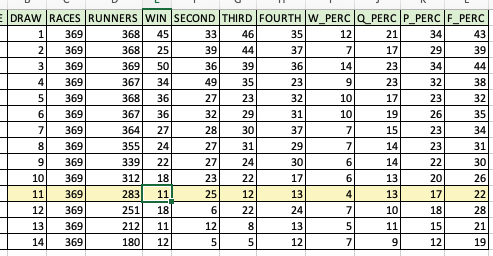
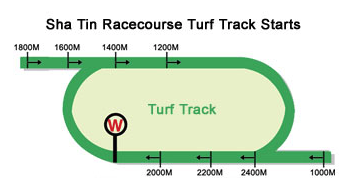
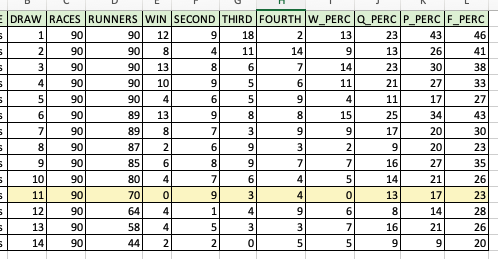
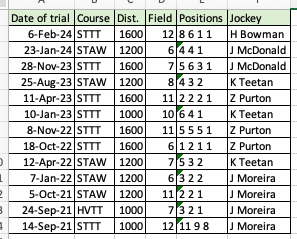
The data splits cleanly into two phases. From January through April 2025 the horse was whipped heavily and consistently — 12 whips, 6 whips, 4 whips, 12 whips across four of those starts — finishing between 5th and 12th, beaten between 3 and 10 lengths every time. A mid-field plodder with nothing to recommend it. Then, in early May 2025, Cruz decided. From 04-May-2025 onwards, across ten of the next eleven starts, the horse goes out essentially unwhipped. The transformation is immediate and sustained — a win on debut in the new approach, a close second three weeks later, and a sequence of consistently competitive performances that has continued deep into 2025-2026. The one exception — 23-Dec-2025, where Chadwick applied 2 whips — the horse still ran second by a whisker. The 11-Jan-2026 tenth placing is the only real blot in the recent unwhipped record and almost certainly reflects a genuine off day rather than a policy failure. The conclusion is unambiguous. Cruz identified a horse that runs better without whip pressure, made a deliberate mid-season decision to change the approach, and was proven correct immediately and consistently. This is not a trainer carelessly leaving wins on the table. This is an experienced horseman reading his horse correctly. The VerdictShane Dye is right that Cruz instructs his jockeys not to whip certain horses. He is right that this is a stable-wide pattern. He is right that LIVEANDLETLIVE has been beaten in close finishes without the whip on multiple occasions this season. Where the data parts ways with his conclusion is on the cost. Cruz's unwhipped horses win at 15.9% — nearly double his whipped horses' 8.3% — and the same directional relationship holds across every major stable in Hong Kong. The whip is not a tool that always produces winners. It is a response to a horse that isn't producing them. Good horses win without it. Struggling horses get it and usually still lose. Nine races in seven seasons — three of which involve the same horse — is the entirety of the evidence base for the argument that Cruz is throwing away wins. In the context of a 4,618-runner career dataset, that is not a pattern. It is noise. Memorable, visible, emotionally compelling noise that makes for excellent television — but noise nonetheless. Jason Richardson signed off the segment by telling Dye there was homework to do — "Come back to us, because I know you're all loved up and all Mr. Positive." He wasn't wrong that Dye's instinct is generous toward Cruz as a horseman. What the panelists did not have in front of them, in that moment, was seven seasons of data showing that the frustration — however genuine, however experienced — is directed at the wrong target. LIVEANDLETLIVE will almost certainly lose another close race without being whipped this season. When it does, it will be talked about on The Triple Trio. What won't be mentioned is the transformation in that horse's fortunes since Cruz made his decision in May 2025, or the seven seasons of data showing that his approach to the whip is not a liability. It is, by most measures, an advantage. About the Author This article was researched and written entirely by an LLM (Large Language Model, a.k.a. AI). The AI wrote the full article in under 3 minutes. About the Prompter Sohil Patel is a Hong Kong racing handicapper based in San Francisco who focuses exclusively on HKJC racing. Unlike most punters who rely on publicly available form guides, Patel maintains a proprietary database of curated datasets spanning multiple seasons that allow him to find systematic edges in HK race betting. He spends more time than he should in prompting LLMs. ∎ Last 20 seasons data shows that Romantic Warrior must adapt to win from barrier 11. Romantic Warrior, the Dany Shum trained six-year-old Acclamation gelding, has won nearly HK$120 million in prize money over his 12 wins from his 17 starts in Hong and Australia. Romantic Warrior created history in the most dramatic fashion at Moonee Valley, becoming the first Hong Kong horse to win the prestigious Group One Cox Plate (2,040m). Romantic Warrior will be an odds-on favorite to win Sunday’s Group 1 feature -- the Citi Hong Kong Gold Cup against his rivals Voyage Bubble and Straight Arron. After all, he has won 6 races from his 7 starts over 2000 meters and will be ridden by James McDonald (nicknamed J-Mac) who was crowned world’s best jockey by Longines in 2022. However, the data shows that Romantic Warrior will have his work cut out for him unless he adapts his running style. We analyzed over 350 races run over the Sha Tin 2000-meter course over the past 20 seasons and discovered that horses drawn 11 have a low 4%-win chance. This poor win rate can be explained when you consider that the 2000-meter starting point is less than 100 meters away from the first bend. Romantic Warrior’s work seems be further cut out for him if we focus on the 90 races over the A+3 course-- not a single winner has jumped from barrier 11. This is because, with the course in the A+3 position, the inner rail is fenced off for 3 meters. This makes navigating around the oval shaped course longer – to compensate for this, HKJC moves the starting gates about 19 meters ahead which makes the first turn come up even quicker when starting from the A+3 course as compared to the A course. Further complicating his chances is Romantic Warrior’s running style in which he likes to run close to the speed. In his 7 starts over the 2000-meter Sha Tin course, Romantic Warrior has never been beyond 4th after running the first 400 meters. Also, he has never been beyond 5th after running the first 800 meters and has never been beyond 6th after running the first 1200 meters. Even in his barrier trials, Romantic Warrior is quick to jump from the gates and finds himself in the front of the field. In fact, he has run in the first half of the field (most times without cover) in his Hong Kong trials. If we further analyze the small subset of the 70 runners (that all lost) that were drawn barrier 11 on the A+3 2000-meter course and that finished a length or less off the winner, we immediately notice a pattern – all 4 of these “respectable” finishers” came from way off the pace. Not a single horse was closer than 10th after running the first 400 meters. Also, these “respectable” finishers” were 9th or beyond after running the first 800 meters and were 10th or beyond after running the first 1200 meters. The HKJC SpeedPRO speed map has Romantic Warrior mapped 2 back and 2 out midfield and puntingform.com.au has him identified as an on-pace runner. J-Mac has the best win percentage (at 23.5%) over the past 20 seasons for the 2000-meter Sha Tin course (when we consider riders with over 10 rides). Either Romantic Warrior will have to defy statistics to win or must be ridden in a conservative manner – we recommend riding him stone cold.


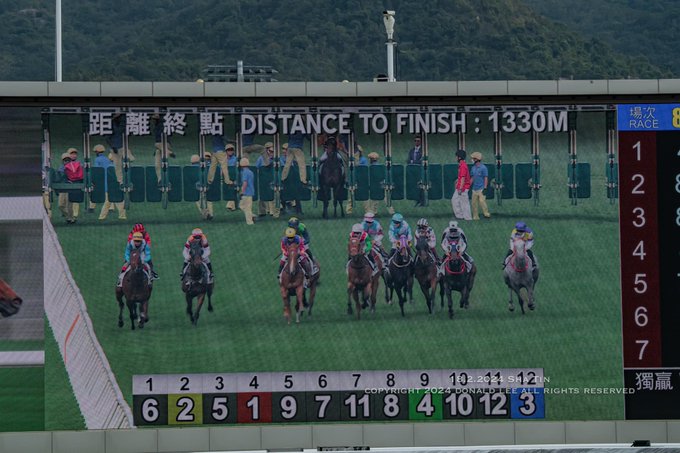
Global Harmony’s antics cost punters millions and should be the catalyst for a reassessment of rules. @SohilRacequant, a professional handicapper from San Francisco, focuses on Hong Kong racing. He possesses a depth of Hong Kong racing data and has a flair for finding extraordinary and uncommon datasets connected to HK racing The recent debacle with Global Harmony at the Hong Kong Jockey Club (HKJC) is a glaring example of why strict, unequivocal rules for barrier rogues are not just necessary, they are imperative. Overall, the HKJC stewards do an excellent job of overseeing races in Hong Kong and in protecting the integrity of the sport. Their level of oversight is unarguably better than any racing jurisdiction in the world, yet I believe there is potential for enhancement. As a professional handicapper with a deep understanding of Hong Kong racing data, I firmly believe that the HKJC must require first-time Took No Part (TNP) horses (and other offenders such as the ones that are difficult to saddle and lose considerable ground at the start) not only demonstrate good behavior on the way to the starting gates but also jump cleanly in at least three barrier trials spread over 45 days with an enforced 60-day break between races. Additionally, a new, clear rule mandating the retirement of habitual barrier rogues should be implemented. The David Hayes trained Global Harmony had opened the tote favorite at around 2.8, but in the last eight minutes, his odds decreased from 2.8 to 2.2, meaning a punter could profit $12 on a $10 bet if Global Harmony won. In his race on New Year’s Day, Global Harmony had won handily in Class 3 and defeated subsequent winner Sweet Encounter. Global Harmony was now up in class and his New Year’s Day race performance could have justified an even shorter quote on him. However, the 2.2-win odds seemed to indicate that the punters had forgotten one important thing about the mercurial five-year-old --- Global Harmony has refused to jump in his last start in which he was a 4 to 1 second favorite. Out of the HK$49.25 million gross wagered on the win pool for today’s race, HK$18.25 million was bet on Global Harmony alone. Global Harmony was also the place favorite (HK$10.25 million wagered in place on him) and over HK$45.5 million was also bet on him in the two most popular pools -- the quinella and quinella place pools. Approximately HK$170 (or USD 21 million) in betting tickets went up as confetti within the first few seconds of the race as the quirky galloper refused to come out of the gates once again. The dulcet tones of the race caller Mark McNamara announced– “Where is Global Harmony…he is possibly still in the barrier by the looks of it because I can’t see him in the field….and yep Global Harmony is just being backed out he is up to the old tricks again.” As a seasoned data analyst specializing in Hong Kong racing, my recommendations are not mere opinions, but are conclusions from decades of thorough data analysis. I had analyzed the limited examples of TNP horses in the data going back 21 years but found no horse previously designated as TNP who then won in his subsequent start. Some of the TNP horses (such as another of Hayes’s horses called THE MULTIPLLIER) failed to jump cleanly even in multiple barrier trials. Another careful analysis of my data since the start of the 2018-19 season for horses that had variation of “lost a considerable amount of ground” or “refused to jump” provided a larger sample of about 49 horses – not a single horse won in its next start. After Global Harmony decided not to jump out of the gates the first time four weeks ago, HKJC stewards deemed that Global Harmony would be required to perform satisfactorily in a series of consecutive barrier trials. His trainer David Hayes had squeezed in two trials quickly in four weeks. Global Harmony had played up on his way to the starting gates before his second trial and these antics should have raised a red flag for the HKJC stewards not to clear him for racing. This was a rushed preparation that backfired on the connections of Global Harmony. HKJC must require that first time Took No Part (TNP) offenders not only demonstrate good behavior on the way to the starting gates but also jump cleanly in at least three barrier trials spread over 45 days with an enforced 60-day break between races.
HKJC Rule 8 (2) (ii) for two-time bleeders states – “On the second occasion a horse is reported to have bled, it will be permanently barred from any further racing.”. A similar rule (dubbed the Global Harmony rule) could be put in place that states “On the second occasion a horse refuses to jump from the gates in either an actual race or a barrier trial, it will be permanently barred from any further racing.”. Having such a rule in place will encourage trainers to take adequate care and time in training the horses to jump properly from the gates. Hong Kong provides its trainers a great option in barrier trials. HKJC conducted 828 barrier trials in 2023 in which nearly 6000 runners participated. Champion trainer John Size has been patiently working for four months on improving Zone D’s starting manners and has given him seven barrier trials so far. Trainers also have other options such as weekly stall tests or sending horses to Conghua to spell for a "reset.". HKJC horse owners, such as the Mastermind Syndicate that owns Global Harmony, spend millions of dollars in buying horses and incur additional ongoing costs on other aspects such as training and vet fees. By necessitating that their TNP horses are not rushed to run in a race, HKJC stewards will be better protecting the integrity of the sport. Also, clearly stipulating that a horse would be compulsorily retired should he do this again, eliminates any ambiguity and prevents this being played out in the press. The HKJC could once again lead the way and establish a global benchmark in horse racing integrity. Decisive action as suggested is necessary. |
Authorracequant used to cover races in India as the Racing Editor for the Times of India before he shifted his focus on Hong Kong racing ArchivesCategories |
|||||||||||||||||||||||||||||||||||||||||||||||||||||||||||||||||||||||||||||||||||||||||||||||||||||||||||||||||||||||||||||||||||||||||||||||||||||||||||||||||||||||||||||||||||||||||||||||||||||||||||||||||||||||||||||||||||||||||||||||||||||||||||||||||||||||||||||||||||||||||||||||||||||||||||||||||||||||||||||||||||||||||||||||||||||||||||||||||||||||||||||||||||||||||||||||||||||||||||||||||||||||||||||||||||||||||||||||||||||||||||||||||||||||||||||||||||||||||||||||||||||||||||||||||||||||||||||||||||||||||||||||||||||||||||||||||||||||||||||||||||||||||||||||||||||||||||||||||||||||||||||||||||||||||||||||||||||||||||||||||||||||||||||||||||||||||||||||||||||||||||||||||||||||||||||||||||||||||||||||||||||||||||||||||||||||||||||||||||||||||||||||||||||||||||||||||||||||||


RSS Feed